
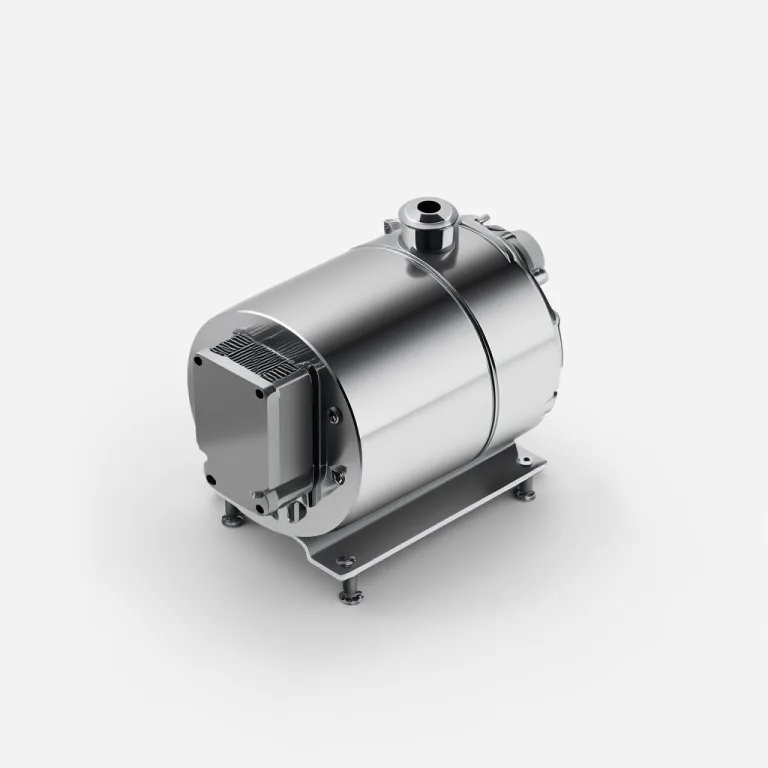
Sanitary Centrifugal Pump
Sanitary Centrifugal Pump for industrial applications.
About Sanitary Centrifugal Pump
Sanitary Centrifugal Pump for industrial applications.
| Domain | electrical |
|---|---|
| Product Family | Pumps |
Who Works With Sanitary Centrifugal Pump?
10 engineering roles are connected to Sanitary Centrifugal Pump based on verified research evidence.
Maintenance Technician
Safety Officer
Quality Assurance Technician
Quality assurance personnel is a recognized professional role in industrial engineering contexts, especially critical in chemical applications where compliance with safety and quality standards (e.g., ISO 9001, ASME BPE, or GMP) is mandatory. In the context of Filter Presses for industrial chemical applications, QA personnel inspect manufacturing processes, verify material certifications, witness performance tests (e.g., pressure integrity, filter cloth compatibility), and manage quality documentation. 'Personnel' is generic but maps unambiguously to the standard occupational title 'Quality Assurance Technician' (or Engineer, depending on seniority); however, 'Technician' is the more common and appropriate canonical form for hands-on QA roles tied to equipment verification and compliance checks.
Validation Engineer
Validation Engineer is a well-established professional role in regulated industries (e.g., pharmaceuticals, chemicals, food & beverage), responsible for verifying that equipment and systems perform as intended under specified operating conditions. In the context of cartridge filter housings for corrosive chemical plant environments, this role directly engages in validation protocols — including design qualification (DQ), installation qualification (IQ), operational qualification (OQ), and performance qualification (PQ) — to ensure compliance with safety, material compatibility, and filtration integrity requirements. The evidence confirms validation activities are explicitly referenced alongside specification and inspection for this product.
Research and Development Engineer
R&D Engineer is a widely recognized professional role in engineering domains, including automation and mechanical test equipment. In the context of torsion testing machines, R&D Engineers contribute to design innovation, performance validation (e.g., compliance with ASTM E143/ISO 7800), and specification of functional requirements. The evidence confirms collaboration with QA and involvement in calibration and system operation — aligning with DESIGN, TEST, and SPECIFY relationships. 'R&D' is a standard functional specialization, not product-specific.
Control Systems Engineer
Motion Control Engineer is a widely recognized, distinct engineering role within industrial automation, specializing in the design, integration, and validation of motion systems—including servo motors, drives, and motion networks (e.g., EtherCAT, CANopen). While 'Motion Control Engineer' includes a domain qualifier ('Motion'), it denotes a well-established specialization—not merely a product-specific title—supported by industry practice (e.g., job postings at Rockwell Automation, Bosch Rexroth, Yaskawa) and professional societies (ISA, IEEE). It generalizes to 'Control Systems Engineer' as the canonical broad role, with 'Motion Control' as a valid, accepted specialization. The role directly engages with servo motors and actuators across the lifecycle: specifying motor/drive combinations, designing motion profiles, commissioning integrated systems, troubleshooting dynamic performance issues, and validating control accuracy.
Process Engineer
Beverage Process Engineer is a recognized engineering role specializing in process design, validation, and compliance for beverage manufacturing systems. While 'Beverage' denotes industry context (not product-specific specialization), the role directly engages with ribbon blenders — particularly in specification, commissioning (including IQ/OQ), CIP/SIP integration, and 3-A sanitary validation — all cited in job listings. 'Process Engineer' is the canonical, general professional title; 'Beverage' reflects domain application, not an inseparable part of the core role definition.
Technical Support Engineer
Technical Support Engineer is a widely recognized professional role in engineering industries, especially in equipment-intensive domains like HVAC&R. The parenthetical '(HVAC&R)' denotes domain specialization—not product-specific title—consistent with standard industry usage (e.g., 'Technical Support Engineer (HVAC)', 'Technical Support Engineer (Power Systems)'). Evidence confirms this role directly engages with brazed plate heat exchangers through selection, sizing, and troubleshooting — core technical support functions aligned with the product context.
Process Operator
Freezer Operator is a widely recognized frontline operations role in food and beverage processing, specifically tasked with running, monitoring, and performing basic maintenance on freezing equipment such as IQF tunnel freezers. While 'Freezer Operator' includes a product-specific modifier ('Freezer'), the underlying professional role is standardized as 'Process Operator' (a core industrial operations function), with specialization in thermal processing/freezing systems. Evidence from FoodProcessing.com confirms its use as a real job title requiring IQF-specific competencies, HACCP, GMP, and preventative maintenance — all consistent with operational ownership of the equipment.
Pump Operator
Peristaltic Pump Operator is a functional job title used in chemical process industries to denote personnel responsible for operating, monitoring, and performing basic interventions on peristaltic pumps in chemical feed systems. While 'Peristaltic' specifies the pump type, the core professional role is 'Pump Operator' — a widely recognized operations role in industrial chemical, water treatment, and pharmaceutical settings. Evidence confirms operator-level positions requiring hands-on experience with peristaltic metering pumps in chemical feed systems, supporting its legitimacy as a real-world operational role.