
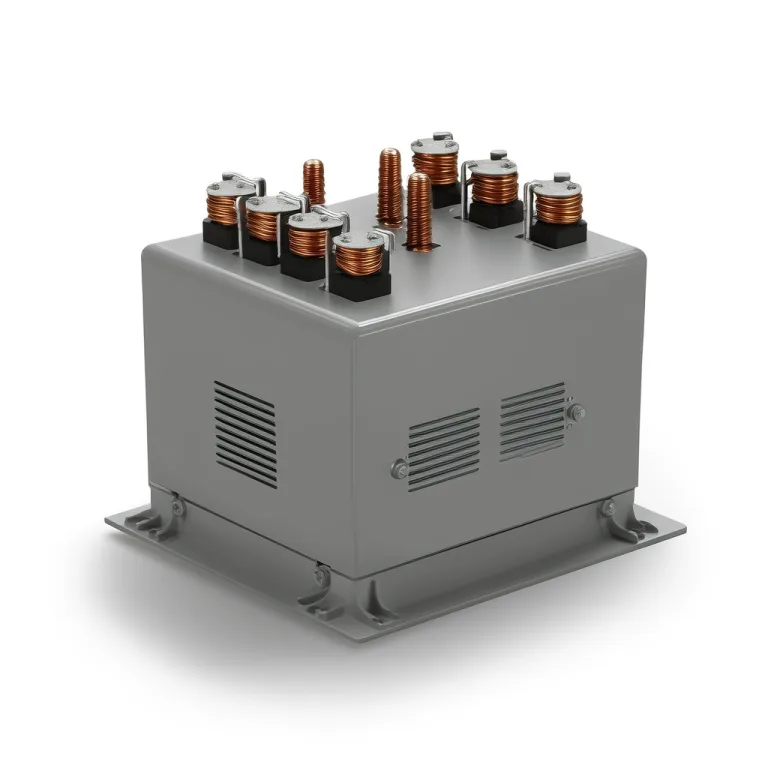
Isolation Transformer
Isolation Transformer for industrial applications.
About Isolation Transformer
Isolation Transformer for industrial applications.
| Domain | electrical |
|---|---|
| Product Family | Transformers |
Who Works With Isolation Transformer?
13 engineering roles are connected to Isolation Transformer based on verified research evidence.
Electrical Engineer
Commissioning Engineer
Power Systems Engineer
Automation Engineer
Automation Engineer is a widely recognized professional role in industrial engineering, particularly in contexts involving PLC-based control systems. The evidence explicitly links it to PLC programming at ABB — a major industrial automation vendor — confirming its legitimacy and functional relevance to PLC Controllers. While closely associated with PLCs, the title is not product-specific (e.g., not 'PLC Controller Automation Engineer'), so canonical form remains 'Automation Engineer'. It encompasses system-level design, logic implementation, commissioning, and validation of automated control solutions.
Control Systems Engineer
Motion Control Engineer is a widely recognized, distinct engineering role within industrial automation, specializing in the design, integration, and validation of motion systems—including servo motors, drives, and motion networks (e.g., EtherCAT, CANopen). While 'Motion Control Engineer' includes a domain qualifier ('Motion'), it denotes a well-established specialization—not merely a product-specific title—supported by industry practice (e.g., job postings at Rockwell Automation, Bosch Rexroth, Yaskawa) and professional societies (ISA, IEEE). It generalizes to 'Control Systems Engineer' as the canonical broad role, with 'Motion Control' as a valid, accepted specialization. The role directly engages with servo motors and actuators across the lifecycle: specifying motor/drive combinations, designing motion profiles, commissioning integrated systems, troubleshooting dynamic performance issues, and validating control accuracy.
Safety Engineer
Safety Engineer is a well-established professional role in automation and industrial control systems; 'Senior' denotes experience level, not specialization. In the context of Crane Anti-Collision Systems (safety-critical automation), Safety Engineers are responsible for hazard analysis (e.g., ISO 13849, IEC 61508), safety architecture design, validation, and compliance verification. Bosch’s use of this title for Crane Anti-Collision Systems confirms domain relevance.
Test Engineer
Thermal Test Engineer is a recognized engineering role specializing in thermal performance evaluation; evidence confirms its use in HVAC contexts involving heat flux sensors, data logging, and system diagnostics. While 'thermal' denotes a domain specialization, the core role is 'Test Engineer'—a widely accepted professional title in engineering practice. It is not product-specific (e.g., not 'Heat Flux Sensor Test Engineer'), so product_specific_title = false.
Maintenance Technician
Design Engineer
Robotics Engineer
Robotics Engineer is a widely recognized professional engineering role in automation and industrial robotics domains; the evidence explicitly states they design, build, test, and deploy robotic systems—including industrial robots—and collaborate with operators/technicians for reliability and efficiency.
Laboratory Technician
Laboratory Technician is a widely recognized professional role in industrial and chemical contexts, responsible for performing analytical tests (e.g., filtrate clarity testing) to verify process performance and product quality. The evidence explicitly links sampling and testing of filtrate clarity — a core quality control activity — to the Filter Press operation, placing the Laboratory Technician in a direct testing and inspection relationship with the product.
Biomedical Equipment Technician
The term 'Medical Air Compressor Technician' is a product-specific variant of the widely recognized professional role 'Biomedical Equipment Technician', which is formally defined in healthcare technology management (HTM) standards (e.g., AAMI, CBET certification pathways). The evidence explicitly states Bioservice seeks a 'Biomedical Equipment Technician' with experience in medical air compressor packages — confirming this is a specialization within that canonical role. While 'Medical Air Compressor Technician' is used operationally, it is not a standalone, nationally accredited title; rather, it reflects domain-specific application of biomedical equipment technician competencies focused on medical gas systems (ISO 7396-1, NFPA 99).